I had lessons in sign-language when I was 11-12 years old. My teacher gave me a sign-language name as part of my lessons. Making the sign for the letter ‘B’ I place my right hand to the right side of my forehead and make a curly movement with my letter ‘B’ out to the right of my face. This sign-name is combining the word for daydream with the first letter in my name.
I love daydreaming.
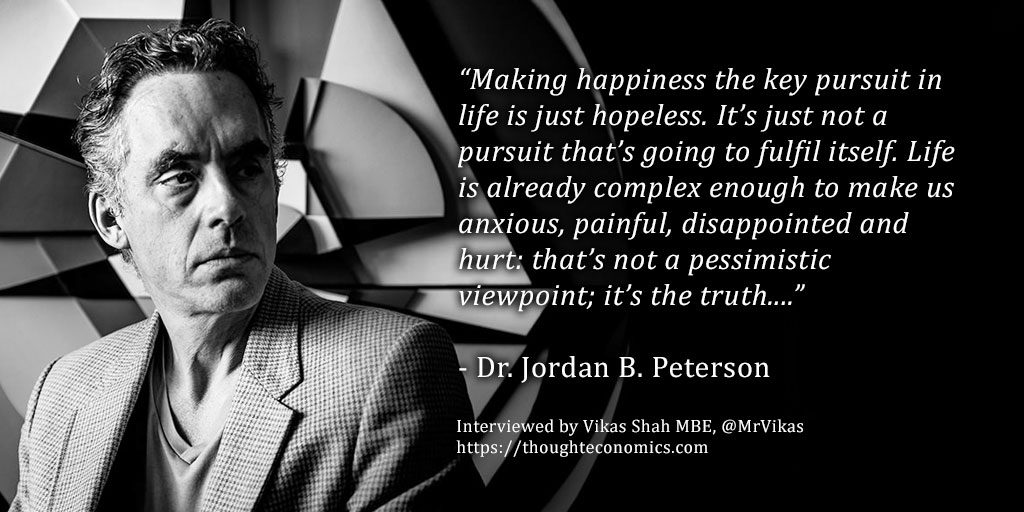
Jordan Peterson says that when you do something new you discover a part of you that you didn’t know was there. That’s a paraphrase of a much more extensive lecture he gave on the subject, but that was the essential message I got.
What part of myself is yet undiscovered? I want to find out. So, considering my propensity for day dreaming, and understanding that I can type quickly, combined with my deep rooted insecurities about disappearing in the mass of humanity without a ripple left behind, I will start writing stories. If I publish or don’t it doesn’t matter much, though of course I’d rather become a published author. What I want is to create something meaningful that comes from the uniqueness that is my combination of human aspects.
I spend so much time gazing up at the sky through the leaves and imagine another being enduring diverse adventures from worlds away gazing at such a sky with contemplation’s of great pith and moment. Perhaps I might be able to increase the joy and fullness of another person with such imaginations as well. I hope I discover that my true self can write stories that influence the world for good.
There are few things that astonish me greater in the world than to meet a human being who hasn’t seen The Princess Bride. It’s.. it’s… Inconceivable!
It may very well be the most quoted movie, at least in my family. Whether we are telling someone to do it Gently! or suggesting they give us a paper cut and pour lemon juice on it, there are so many situations in life that are reflected by the subtle irony portrayed in this film.
Today I’m hearing one such line in my head. “Life is pain highness. Anyone who says differently is selling something.”
My final week in psychology was dedicated to the concept of death. They taught us three terms to define the different aspects of death. Bereavement was the term used to impartially refer to the condition a person is in when someone close to them dies. Grief, obviously, was the feeling that was expected to come because of bereavement. Then mourning was the custom performed to signify that grief and bereavement. I have not yet experienced the kind of bereavement in my life which leads to significant grief or mourning, at least in this sense. So why was is so hard to read that chapter? Why did I feel grief so acutely during this last week? Why was I in pain and what was I mourning?
Jordan Peterson is a psychologist, author, and public speaker that I admire. His messages often focus on finding meaning in one’s life through sacrifice and by intentionally easing misery around us. I hear many such meaningful and good things from Dr Peterson, but he himself deals with crippling depression. I want joy in this life. How can I find it when life feels so meaningless?
In 2 Nephi 2:23 Lehi said that without opposition we “would have remained in a state of innocence, having no joy, for (we) knew no misery; doing no good, for (we) knew no sin.”
I believe that. It makes sense. If I had nothing but ice cream to eat every day, would it be a treat? Would I even like it? Of course not! I’m glad that I have understanding of suffering, loneliness, fear, fatigue, sickness, and misery. If I didn’t know how bad it life can be, how can I appreciate how good life can be?
So why can’t I feel the joy that I think I should have considering my knowledge? If I have to know the evil in order to know the good, does that mean that sometimes I have to be miserable, maybe for an extended amount of time before I can experience Joy?
David A Bednar taught that the Savior is the only source of enduring joy. The prophet Jacob said “The righteous, the saints of the Holy One of Israel, they who have believed in the Holy One of Israel, they who have endured the crosses of the world, and despised the shame of it, they shall inherit the kingdom of God, which was prepared for them from the foundation of the world, and their joy shall be full forever.” Alma also thought that we should have joy in this journey when he said, “…this because of the power of (Christs’) word which is in us, therefore have we not great reason to rejoice?… Now this is my joy, and my great thanksgiving; yea, and I will give thanks unto my God forever”
So, somehow I am supposed to feel this great joy primarily because of the promises given by virtue of the Good News, or gospel of Jesus Christ. Why then does my heart fail me? I don’t know. But as Jacob taught, I will continue to endure the cross of this world and hope for joy to come in the morning.
In the assigned reading this week author Bernard Poduska in his book Til Debt Do Us Part wrote about family rules, especially as they pertain to money management with newly formed family units. My mother was always the budget keeper in the family. To this day, we all know that if we make a purchase for mom, you keep the receipt because she will want it! My husbands family was more the hand-to-mouth style of financial planning. The moment they had money, they found something to do with it before it burned a hole in their pocket! When we got married, my husband and I both knew that having a budget and having self-control was a better way, and so far we have lived frugally and within our means.
Poduska also wrote about the significance of birth order and how oldest children vs youngest children deal with finances. My husband and I are both eldest children from large families. I read through the part of this book about the statistics of money management for the eldest children, second children, middle children and youngest children and conceded a definite reflection of truth, though not complete accuracy in our families. Poduska reported that eldest children had the inclination to be controlling and strict with money. While I can’t deny that we are frugal with our income, I’m glad we haven’t got what the author referred to as “an exaggerated need for control.” His suggestions for those who have a problem in this area are:
1. Bring financial matters into open discussion. As a family we discuss our money issues openly. The children know when and why money is tight.
2. Develop a financial management plan to enable all members of the family to have a say in the budget. Though I teach my children not to discuss the matter with other people, in our home any one may see the budget and balance at any time.
3. Give each member an allowance. We have tried to do this in our home several times and for us it has never worked in a dependable weekly set amount. Instead, any one who has either a want or a need is free to approach the subject of budget with requests. Anything from needed clothing items to the newest cool song they just heard from a friend, if it fits in the budget, it can be purchased.
Reading this weeks assignments and learning about money management types and trends was helpful to my husband and me. We got to evaluate what we were doing right and wrong and have productive conversation which influenced a change in a few things we were not doing well, and helped us feel good about the positive habits we had already created.
The best part about our conversations about our finances was that we recognized that we two had not adopted the totalitarian budget-keeping of my mother, nor the empty-pocketed propensity of his father. We truly had created a balance all of our own that, while not perfect, reflects our unique combined style and identity as a couple.
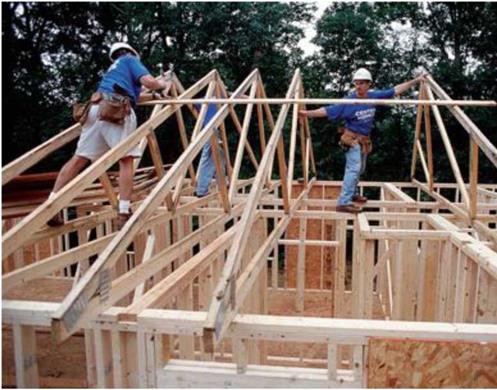
I spent many years as a youth working on construction sites with my dad. Sadly, I lived in a day when pictures were not so easy to obtain, so this is not a picture of a house my dad built.
But it does give you an idea about what it’s like to put trusses up for the roof. Those triangular pieces form the skeleton for the top of the house. The way we put them in place was for my dad to hold the truss in one place, my brother to hold in a second, and me in a third, then all three of us would walk together along the top of a stud-framed wall to the position for that truss. We needed balance. When one of us wobbled, the other two could feel it. With sensitivity we could feel through the truss when one person was leaning and instinctively make balance adjustments for the error. My father was much heavier and better practiced at this activity, and he was like an anchor for the two of his children when they, in their inexperience, leaned too far one way or the other. The three of us made two houses one summer and, thankfully, nobody ever fell off the roof.
This is not unlike the balance needed for a husband and wife as they learn to rule their kingdoms- you know, like the Province of Checkbook Balance, the Land of the Laundry, the Gulf of Dish-Doing, not to mention managing the inevitable uprising of peasantry at bedtime.
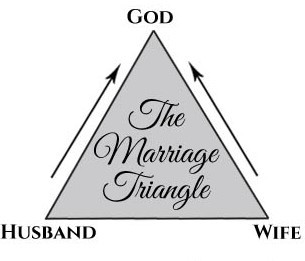
Like balancing a truss into place, a husband and wife precariously build a union one piece at a time. President Eyring taught, “He (Christ) made clear how the gospel of Jesus Christ can allow hearts to be made one. Those who would believe the truth He taught could accept the ordinances and the covenants offered by His authorized servants. Then, through obedience to those ordinances and covenants, their natures would be changed. The Savior’s Atonement in that way makes it possible for us to be sanctified. We can then live in unity, as we must to have peace in this life and to dwell with the Father and His Son in eternity.”
My father warned us about the dangers of setting trusses before we went out on the top of the framed house. And then, if he saw that we needed more instruction as we went along, he made sure to keep warning us. President Eyring also gave a warning about the dangers we are facing as we strive to create unity in our marriages and homes. He warned us of pride and of speaking ill of those with whom we are connected. He counselled us to be sure to keep the commandments, and qualify for the presence of the Holy Ghost. We also need to hold the truss at the same height. Like equally yoked oxen, the burden is carried best when two make a similar contribution. The truss goes into place at both ends at the same time.
It’s no simple thing building a house. I’ve heard many stories of people breaking or losing body parts, even dying because of small mistakes. Building an eternal companionship is not only a more difficult and complicated project, the stakes are higher, and failure will have eternal consequences. This balancing act is amazing, and dangerous.
I feel the danger in my own marriage. I wobble. He wobbles. If I spend my time reacting to my husband’s wobble I’ll fall. If I focus instead on my Savior and learn to balance from Him, I’ll be steadied. His balance is sure. I’m grateful for the continuing instruction I get through revelation and through the words of God’s prophets so that I can maintain balance in this dangerous, but worthy project of building unity in my marriage.