Wk9 – Keep the Change
Category : Uncategorized
My son didn’t enjoy church yesterday. He is 12, almost the youngest in his class, and (how shall I put this?) not the most socially adept. He is experiencing an ongoing problem where the young men in his class have boisterous conversation, he tries to join in, but not in the best of ways, and they react poorly to his attempts. He feels the anguish of being left out and having less acceptance with his peers. Yesterday after church he brought his pain to me once again, as a child will. I’m glad he can bring me his pain. But what I gave him wasn’t what he wanted, at least at first. I listened, I reflected and validated his feelings, and then asked him what could be done.
“Should we tell the bishop about them?” I asked.
“Well, no”
“Should we complain to your teacher?”
“No.” He began to get exasperated.
“Should I come to class with you and make sure the conversation goes well?” I asked with obvious humor.
“Oh yeah!” He said with humor back. “My mommy is going to make you be nice!” We laughed about imagining that. Then I stopped the rhetorical questions. I told him the repair was all up to him.
“Why do I have to fix it?” He wondered. “They are the ones doing wrong!”
“But you and I don’t have any power to change them, you only have the power to change you.” Together we came up with new ways for him to behave to avoid conflict and negativity. We will see how it works out.
I don’t have the ability to change my spouse. Only he does.
A marriage where each party gives a fair 50%, is a marriage doomed to failure. It’s been said that a husband and wife both need 100% dedication to a common cause in order to succeed. So what happens when the “other spouse” isn’t giving their all, or perhaps, is giving 100% of something we don’t like or don’t want? How can we meet in our marital middle while still giving our all?

In John Gottmans book The Seven Principles for Making Marriage Work, he says, “You will not be able to compromise successfully if you don’t accept your partner’s flaws and foibles. Instead, you will be on a relentless campaign to alter your spouse.”
Perhaps the key to working it out is giving our all, and accepting what our spouse gives as their all, in their own way. Though there are circumstances, such as abuse or infidelity, that supersede this patient and forgiving mentality and may require separation or divorce, perhaps making this three way covenant between God and one of His children deserves more dedication than “Until discontent do us part.”
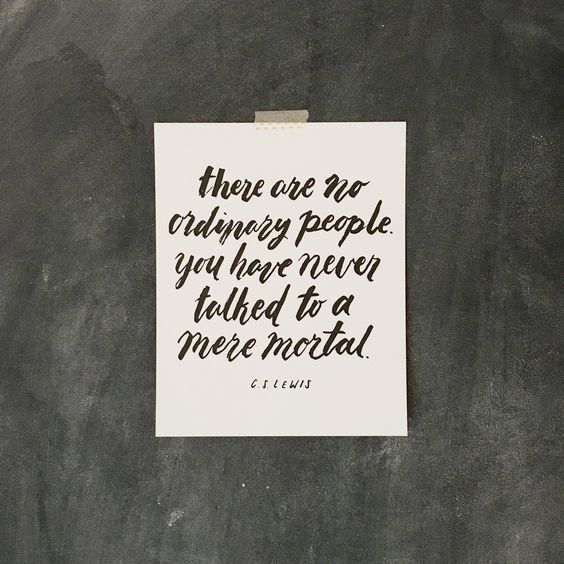
CS Lewis said, “There are no ordinary people. You have never talked to a mere mortal. Nations, cultures, arts, civilizations – these are mortal, and their life is to ours as the life of a gnat. But it is immortals whom we joke with, work with, marry, snub, and exploit…” Though we have a veil drawn over our memories and can not with our eyes see the resplendent nature of our spouses, if we can keep the perspective that our covenants are worth negotiating the toilet seat, the diaper duties, and the checkbook, then our inclination will be to consecrate ourselves to a marriage through its tumultuous days.
As I counseled my son, so I do also. If there is a problem, I make my change for the better. If my spouse decides to do the same, however much and in whatever way for the better, then I’m happy to keep that change too.